When last we talked, I had just received the second round of edits from my editor, Judi. She had some excellent notes on content, writing, story, etc. All the important things for a book.
Then she asked me to do some searches reminiscent of the adverb purge for Sensible Shoes:
PREPOSITIONS.
With and To to be exact. Why you ask?
Which is what I asked AI. He/She/It should know, right? (AI is non-trinary.)
Here’s what He/She/It said.
To improve clarity and precision in your writing, avoid using “with” and “to” excessively by following these guidelines:
- “With” can create ambiguity; use specific nouns instead to clarify relationships.
- “To” may lead to overly complex sentences; simplify by breaking them into shorter statements.
- Overuse of these prepositions can make writing feel cluttered; aim for concise language.
- Consider alternatives that convey your message more directly, enhancing readability.
- Vary sentence structure to maintain reader interest and improve flow.
- Always prioritize clarity over complexity to ensure your message is understood.
I appreciate the information. And, of, course, this makes sense. And notice it says EXCESSIVELY.
Maybe a thousand of each is excessive in a 65,000 word manuscript. So I set out to exterminate as many as possible by rewriting. I started with WITH. I studied every one of over 700 instances. And I will confess, some of them could be changed easily by rewriting the sentence. These examples are from Windshadow:
On the other side of the room, the big stone fireplace crackled with a welcoming blaze.
On the other side of the room, a welcoming blaze crackled in the big stone fireplace.
Peter watched her through narrowed eyes, heavy with concern.
Peter watched her through narrowed eyes, his concern palpable.
His voice was laced with skepticism.
Skepticism colored his voice.
This last one kills two birds with one stone by eliminating passive voice (the use of WAS.)
Mission accomplished. I got rid of about 200 WITHs.
Turning my attention to TO, there were over 2000. Turns out it’s a very popular preposition we mostly don’t realize we’ve used.
And I mostly left them alone, changing only a couple of hundred out of 2000-something. These examples are from The Villa (the new Corfu book I’m writing), because I am still learning with every book.
But her suitcase, stuffed to bursting with a week’s worth of Greek writer’s retreat clothing, was down here, next to her.
But her suitcase, bursting with a week’s worth of Greek writer’s retreat clothing, was down here, next to her. (Notice, I changed the first one, but not the second.)
Apparently, not aerodynamically packed, the duffel slipped off to one side and hit the ground.
Apparently, not aerodynamically packed, the duffel slipped off and hit the ground.
The meaning isn’t changed, but the writing is tighter, with fewer superfluous words.
One side note: After I changed all the WITHs, I realized I had changed many of them to TOs, and a couple ended up with passive voice, so I changed them back to WITH.
Turns out you can overdo a good thing.
I have learned to use common sense, logic, and my own instincts for a lot of this. And Judi is patient and understands all that and trusts me, I think.
Do other editors do this? Judging from the books I’m reading, heck no. Is their writing as good? I’ll let you and the New York Times be the judge of that.
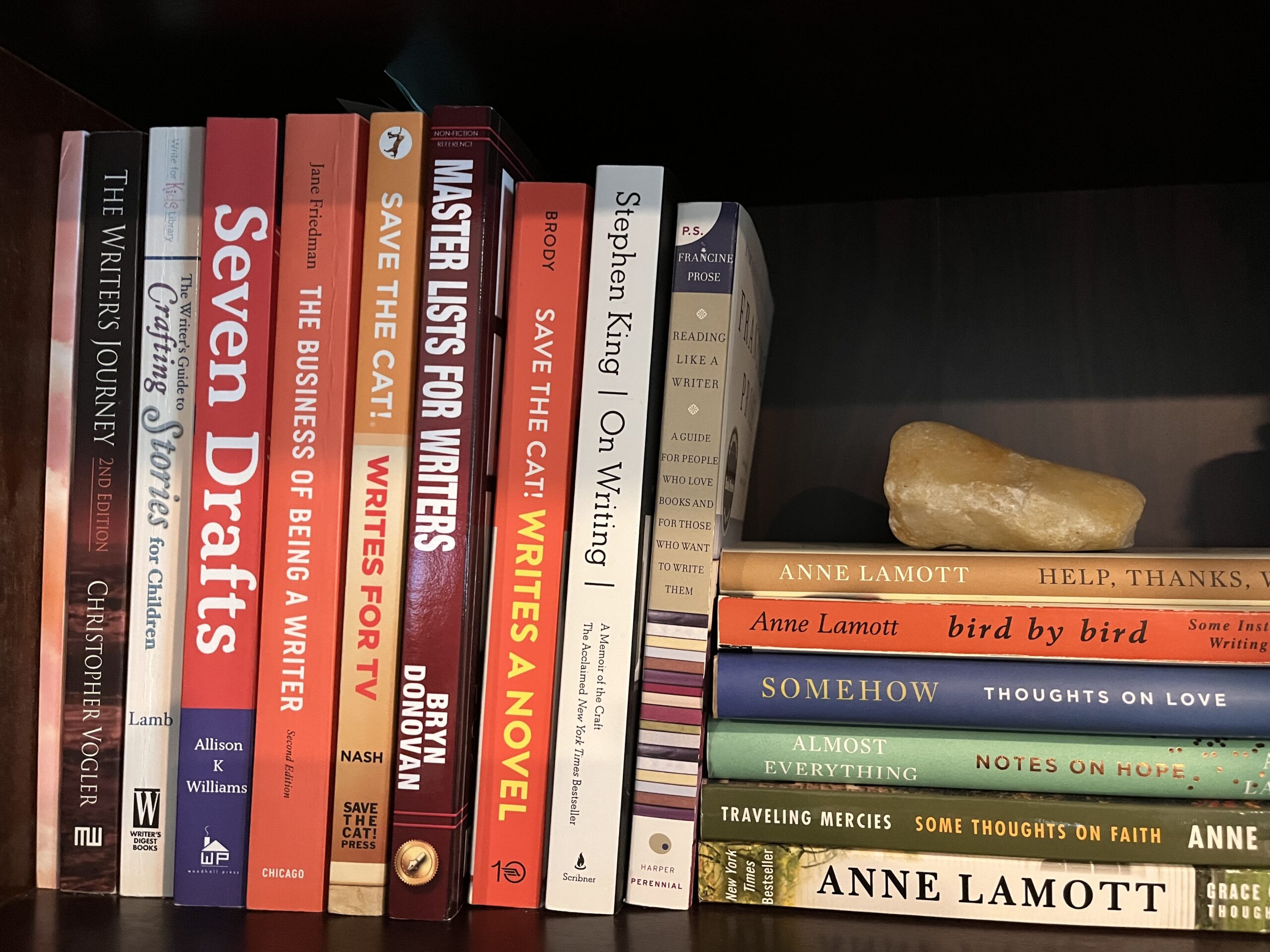
FOOTNOTE: The picture above is a portion of my writing library. I believe there is always something new to learn.